The dangers of emergency stops, and why they don't always do what you think
By Tristan Newton, Commercial Director · 19 December 2025 · 4 min read
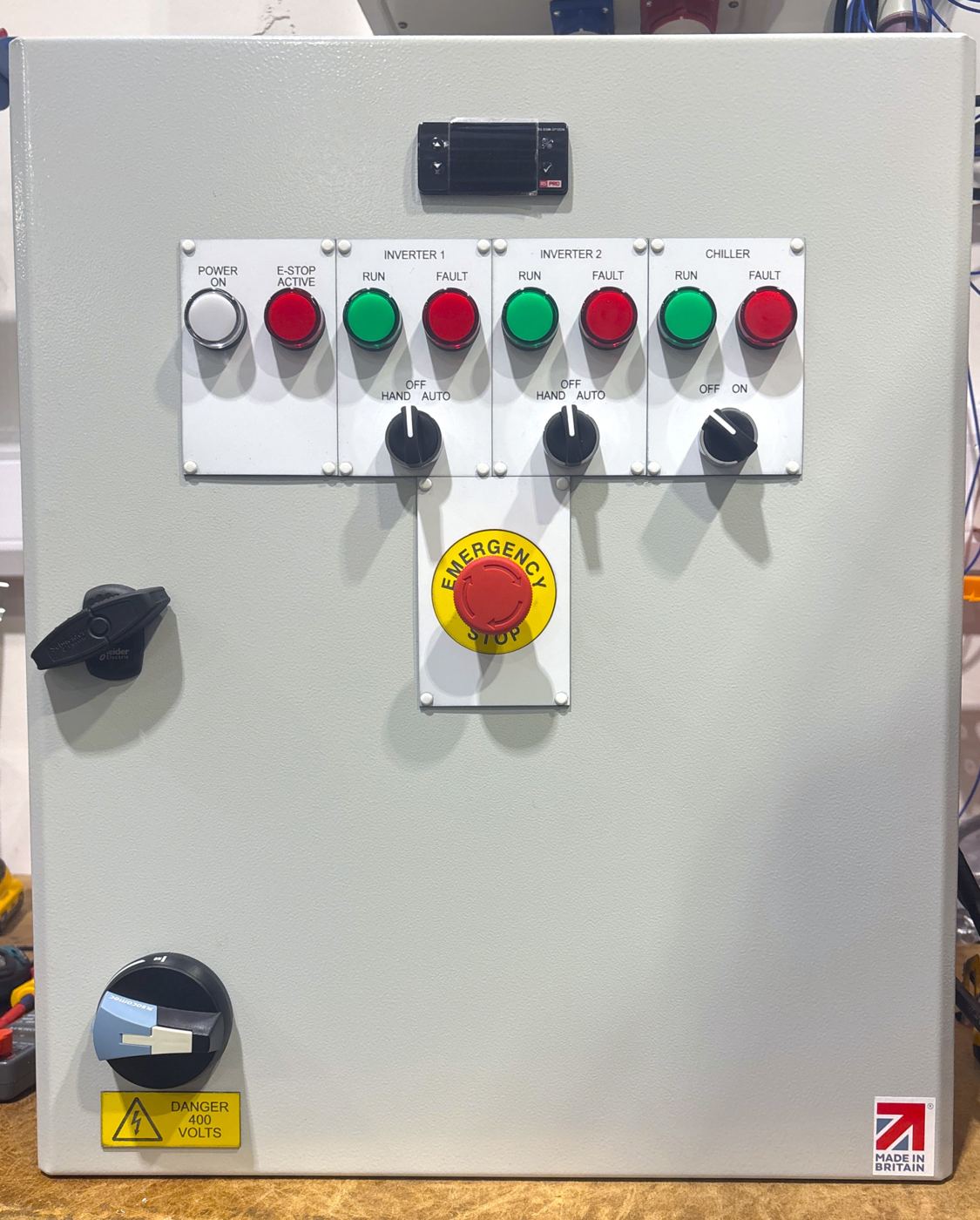
In the industrial world, the "big red button" is a universal symbol of safety. We are conditioned to believe that hitting an emergency stop (also known as an E-stop) acts as a magic wand that instantly renders a machine harmless.
However, this assumption is dangerous. E-stops are complex control devices, and misunderstanding their physical and electrical limitations is a leading cause of avoidable accidents.
Understanding Safety Categories
First of all, let's understand categories of safety. Safety categories are a simple way of describing how the emergency-stop safety circuit is built and how well it copes with faults. In practical terms, they describe whether the safety function is single-channel or dual-channel, whether it has fault detection/monitoring, and whether a single failure (like a broken wire, welded contact, or short circuit) could stop the E-stop from doing its job. Lower categories rely more on basic, single-path control, while higher categories add redundancy and diagnostics so the machine can still be brought to a safe state even if one part of the safety circuit fails.
| Category | Requirement | Behavior on Failure |
|---|---|---|
| Cat B / 1 | Use of well-tried components. | A single fault can lead to the loss of the safety function. |
| Cat 2 | Periodic testing (check-cycles). | A fault can be detected between checks, but a fault between checks leads to loss of function. |
| Cat 3 | Redundancy (Dual Channel). | A single fault does not lead to the loss of the safety function. |
| Cat 4 | Redundancy + High Diagnostic Coverage. | Faults are detected, safety function is maintained even with a fault. |
What an E-stop actually does
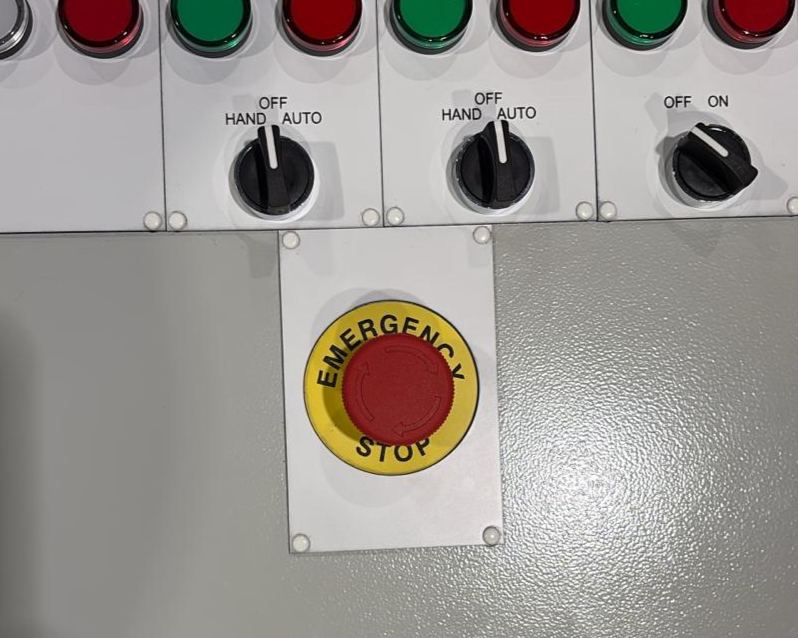
An emergency stop button commands a safety function. When pressed, it changes state, usually opening one or more normally-closed contacts, so a safety controller/safety relay detects the demand and then removes energy from the hazardous parts of the machine, typically by dropping out one or more contactors, disabling drives (e.g., STO), closing valves, or otherwise stopping motion. It also prevents restart until the E-stop is physically reset and a deliberate reset/start sequence is completed. Exactly what it achieves depends on the design: it may remove power to actuators, remove the control signal only, or stop in a controlled way before removing power — but the button itself is just the input that triggers that engineered response.
The "Magic Button"
There is a pervasive belief that hitting an E-stop kills every circuit instantly. In reality, an E-stop typically breaks the control circuit, not necessarily the power circuit. While the "go" signal is removed, motors may coast to a halt rather than stopping dead, and power may still be present at the terminals.
Another danger to consider is an electrical emergency stop does not account for stored mechanical energy. Even after the button is pressed, hydraulic accumulators may hold high pressure, pneumatic cylinders can still actuate, and gravity-loaded arms may drop unexpectedly. In these scenarios, "stopped" does not automatically mean "safe."
Not All Stops Are Created Equal
A critical design flaw in many facilities is the misunderstanding of Stop Categories. Machines are often wired for a Category 0 stop, which cuts power immediately but allows heavy loads to coast. Conversely, a Category 1 stop keeps power on briefly to brake the machine before cutting the supply, while Category 2 maintains power to hold a load in place. If a machine requires active braking but is wired for an immediate power cut, the momentum of the moving parts creates a hazard that persists after the button is pressed.
PLC Emergency Stops
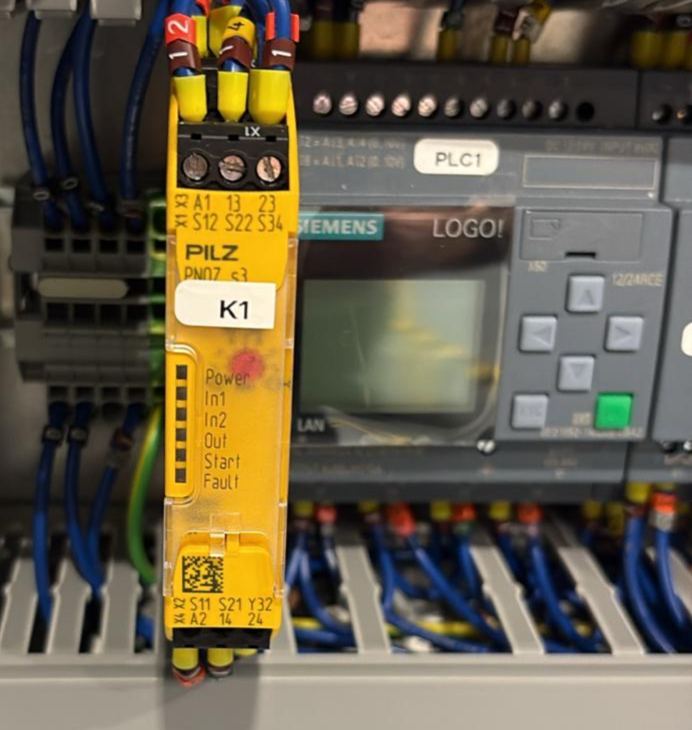
Simply installing a red mushroom-head button does not guarantee safety; the integrity lies in the wiring behind it. Dangerous installations often wire E-stops directly to a standard PLC input. If that PLC freezes or the code hangs, the E-stop stops working. True safety requires dual-channel wiring monitored by a dedicated safety relay or safety PLC. Without this, a single short circuit or a break in the neutral wire can blind the safety system, leaving the machine energized despite the button being depressed.
Response Time and False Security
Physics dictates that nothing stops instantly, there is always a lag—known as response time. This includes the time for relays to drop out, hydraulics to bleed off, and Variable Frequency Drives (VFDs) to ramp down. If an E-stop is placed too far from the hazard, or if an operator relies on an "instant" stop that actually takes seconds, they may enter the danger zone while the machine is still lethal.
Perhaps the biggest danger, however, is psychological. The presence of an E-stop can create a false sense of security, leading operators to bypass guards or ignore Lock-Out/Tag-Out (LOTO) procedures. It is vital to remember that E-stops are reactive measures designed to mitigate damage after something has gone wrong; they are never a substitute for physical guarding or safe design.
The information provided in this blog post is intended for general knowledge and guidance only. It does not constitute professional advice. Please consult a qualified professional for advice specific to your situation before making any decisions based on this information.
Written by the engineers at G&G Controls, a UK control panel manufacturer in Stoke-on-Trent. For general guidance only; consult a qualified professional for advice on your own installation.
Up next
Replacing control panel components
Choosing the right control panel components can be daunting, especially for an onsite engineer having to replace dated parts. Here is a handy overview guide and some things to watch out for. Need components? We keep £100,000's of components in stock, get in contact for pricing and availability.