What's inside a BMS outstation panel
By Tristan Newton, Commercial Director · 7 August 2026 · 4 min read
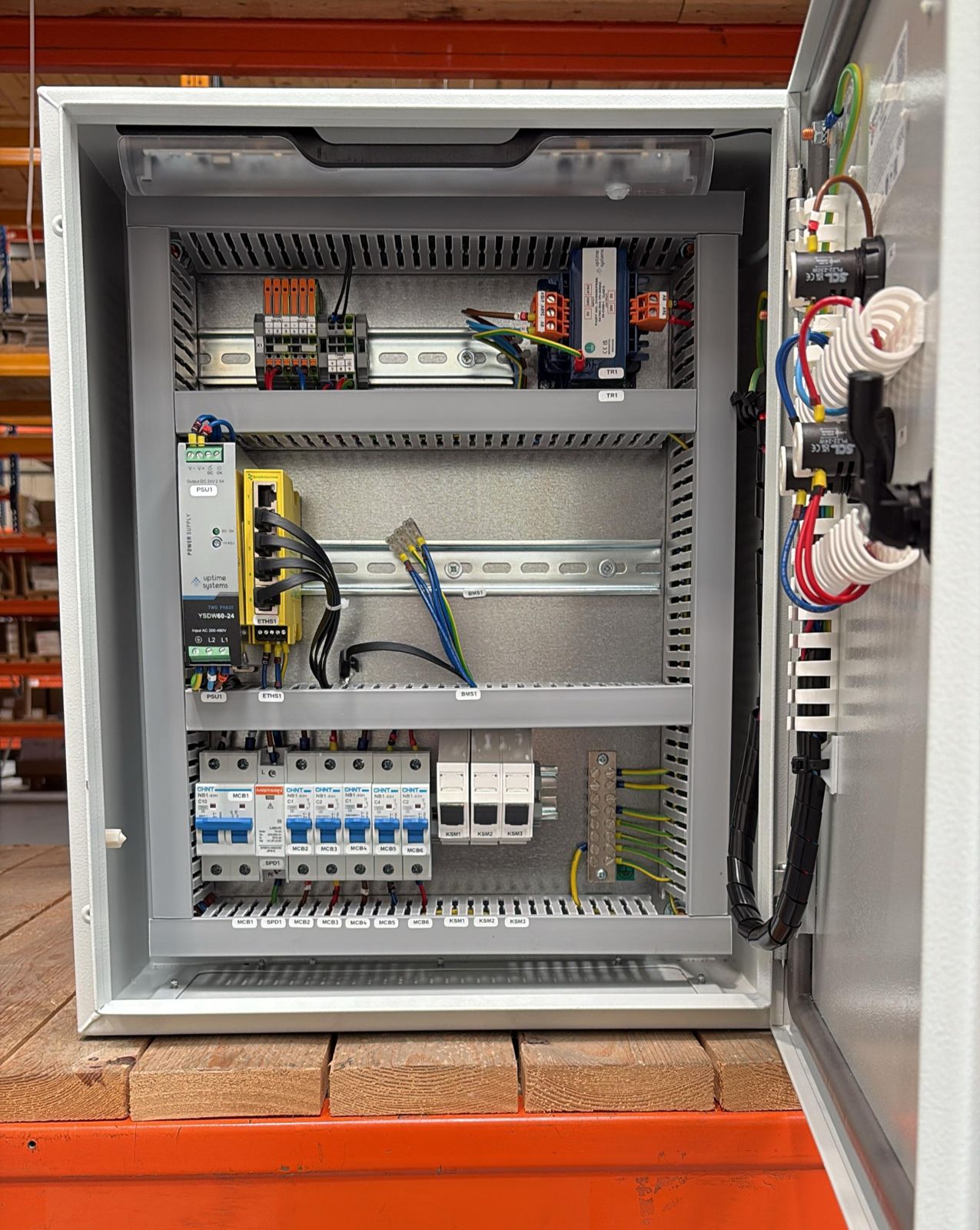
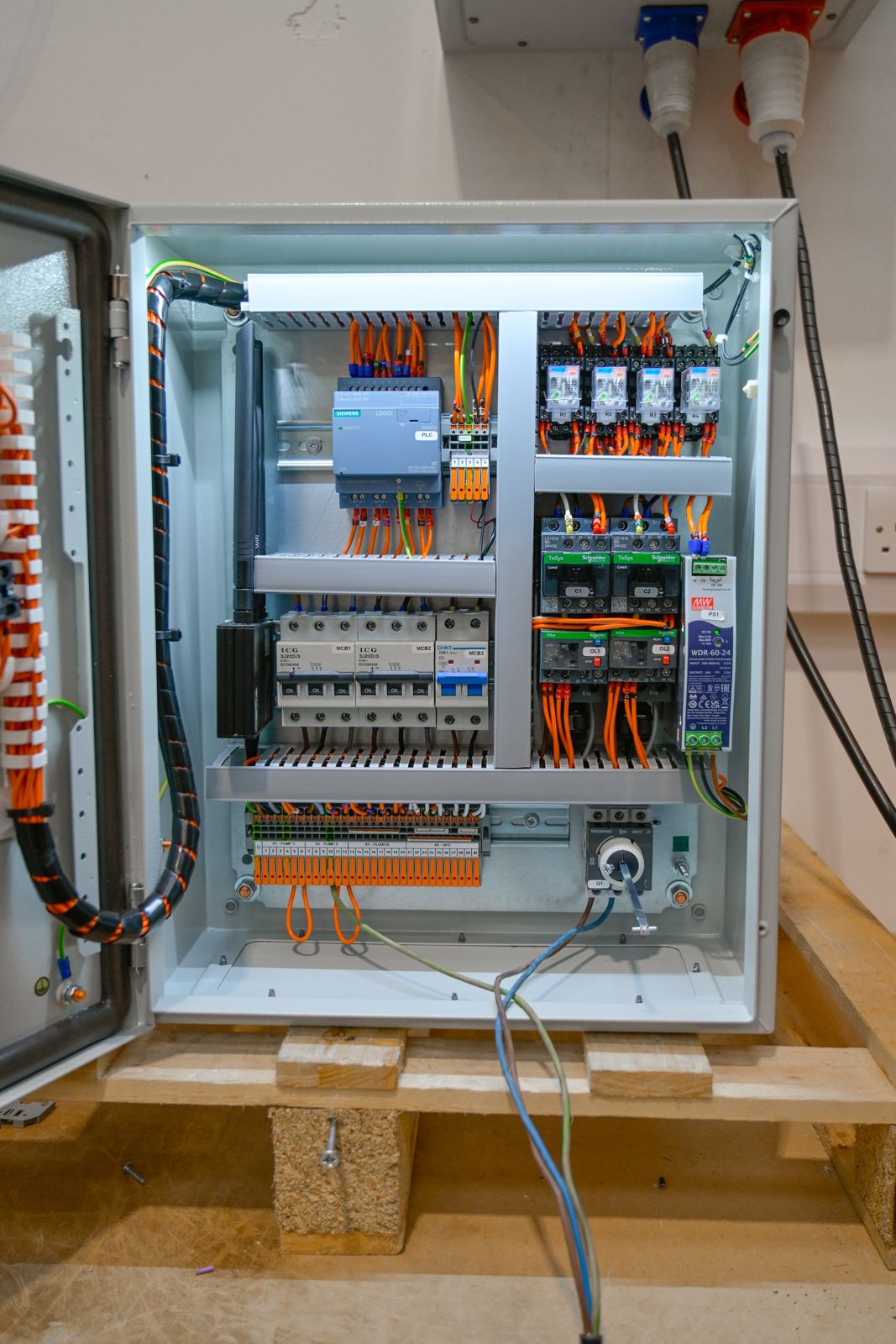
Open the door of a BMS outstation panel and the controller is the part everyone looks at. It is also the part that causes the fewest problems. The trouble on site nearly always comes from what is around it: the power supplies, the surge protection, the network connection and the terminals. Here is what each part does, and what to look for.
The controller
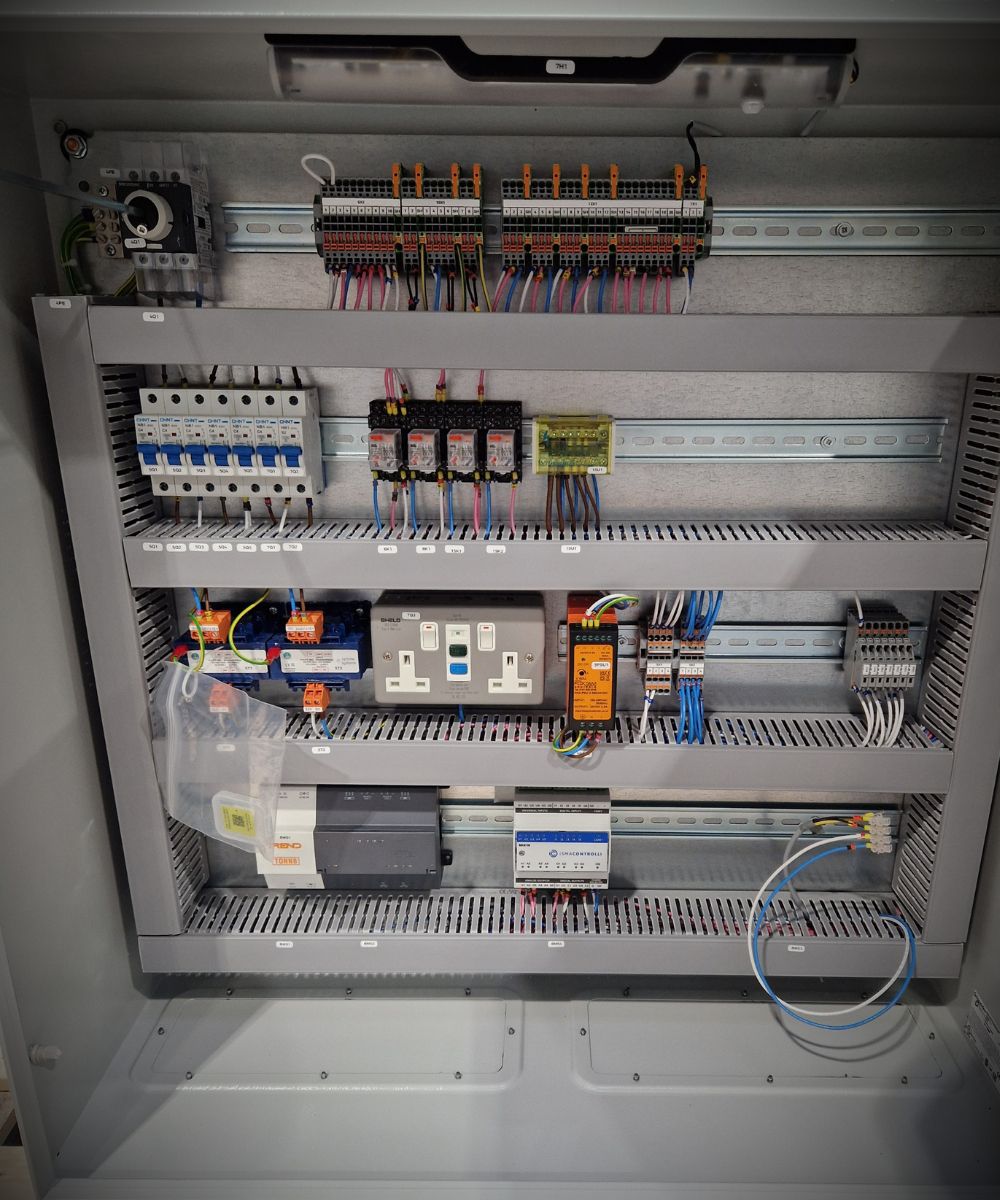
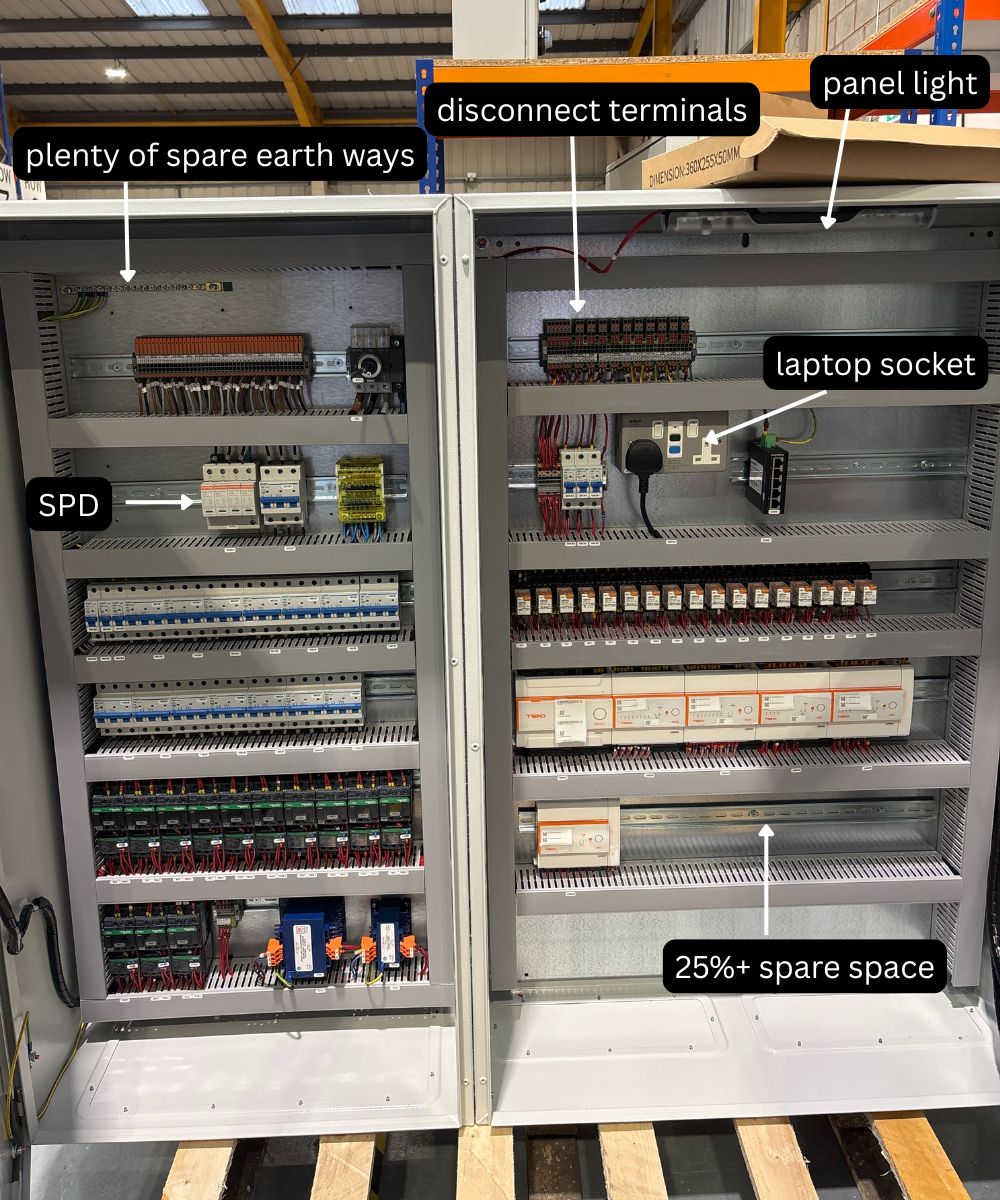
The Trend, Distech, ISMA, Tridium or other controller that runs the strategy, with its expansion modules for extra inputs and outputs. It is mounted on DIN rail, usually in the middle of the panel where it is easy to get at, with its I/O modules alongside. Whether it is supplied by the panel builder or free-issued by the BMS contractor, it is the one component in the panel that the panel builder does not design: it is the one the strategy is written for. Free-issue controllers covers that arrangement.
Two power supplies
Almost every outstation panel needs 24V AC and 24V DC, and needs them separately:
- 24V AC for the older generation of field devices: actuators, valves, some sensors. It comes from a transformer.
- 24V DC for the controller itself, modern actuators, network equipment and sensors. It comes from a switched-mode power supply.
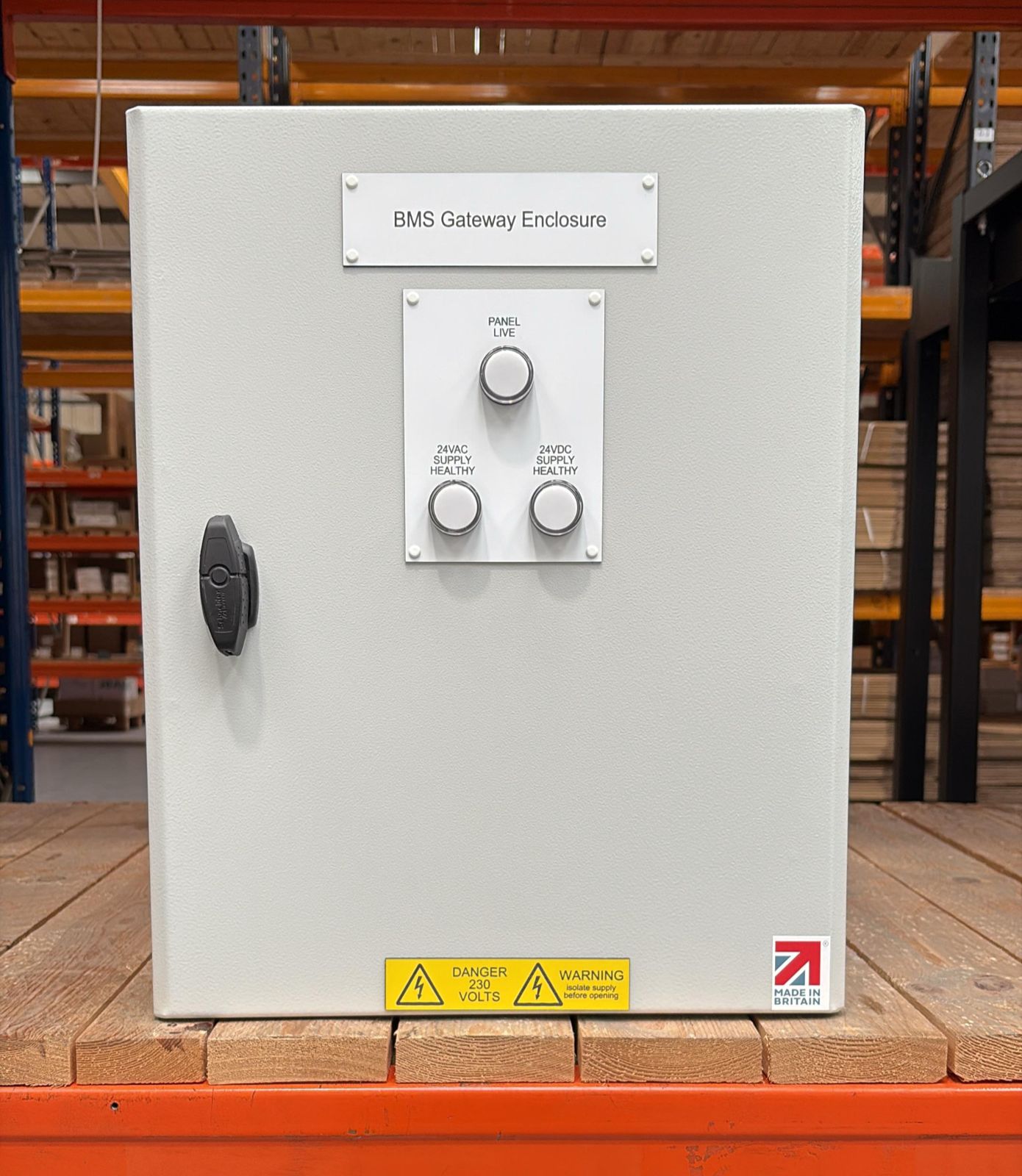
Mixing them up is the classic site fault. A well-built panel keeps them on separate, labelled terminals with separate fusing, and has a lamp on the door for each so an engineer can see at a glance that both are healthy. Our Evometrix Gateway has exactly that: panel live, 24V AC healthy, 24V DC healthy.
Surge protection
A BMS controller is a computer on the end of long cables that run through a building and, often, onto a roof. Lightning does not have to hit the building to induce a spike large enough to kill it. Type 2 and type 3 surge protection on the incoming supply clamps those spikes before they reach the controller and the power supplies. It is a small component and it is the one most often left out to save money. Do you need surge protection in your panel? goes into the standards.
A network switch
The controller talks to the head end, to other controllers and to the engineer's laptop over Ethernet. A managed or unmanaged switch with five or eight ports inside the panel means all of those connect cleanly, with a spare port for the laptop on commissioning day. A panel without one ends up with a consumer switch on a shelf and a power adaptor in a socket, which is how outstations go offline when the cleaner unplugs something.
Relays
Controller outputs are small. Anything that needs switching at 230V, or that needs a clean volt-free contact, goes through an interposing relay: one per digital output, on the rail, with a coil indicator. They protect the controller from the plant and make the output visible.
Terminals
The unglamorous part, and the part an installer spends most time with. Every field cable lands on a numbered terminal that matches the drawing, grouped by signal type and voltage so 230V never sits next to a sensor input. Fused terminals for the field supplies, disconnect terminals for the analogue signals so a loop can be tested without unwiring it. WAGO lever terminals explains why we use them.
The rest
- A panel light, so commissioning does not happen by torch.
- A service socket for the laptop charger.
- Labelling: every cable, every terminal, every device, to the drawing.
- Spare space: 20 to 25 per cent, because points get added.
Why it matters
The controller is perhaps a third of the cost of an outstation panel. The rest is the things above, and they are what decide whether the panel is a pleasure or a misery to commission and maintain. A panel assembled on site from parts to hand tends to have the controller and not much else; a panel built on a standard platform has all of it, tested, before it leaves. That is the whole idea behind Evometrix, and the Gateway version, at £924 + VAT, is the platform with everything but the controller.
Frequently asked questions
Does an outstation panel need both 24V AC and 24V DC?
Almost always. Field devices are a mix of both, and the controller itself needs DC. A panel with only one will need the other adding on site.
What size network switch?
Five ports is enough for most outstations: head end, controller, one or two other devices and a spare for the laptop. Larger panels with several controllers use eight.
Is surge protection required by a standard?
BS 7671 requires a risk assessment for surge protection in most installations, and for a building services controller on long cables the assessment nearly always says fit it. It is far cheaper than a replacement controller and the visit to fit it.
Can I add a controller to an Evometrix Gateway myself?
Yes. It has the DIN rail, the power supplies, the switch and the labelled terminals; the controller clips in and connects. Most BMS contractors fit their own; we fit them too if the controller is sent to us.
Written by the engineers at G&G Controls, a UK control panel manufacturer in Stoke-on-Trent. For general guidance only; consult a qualified professional for advice on your own installation.
Up next
How to write a BMS points list that gets an accurate quote
A points list is the one document that turns a BMS panel enquiry into a price and a drawing. What to put in it, what to leave out, and a template to start from.